

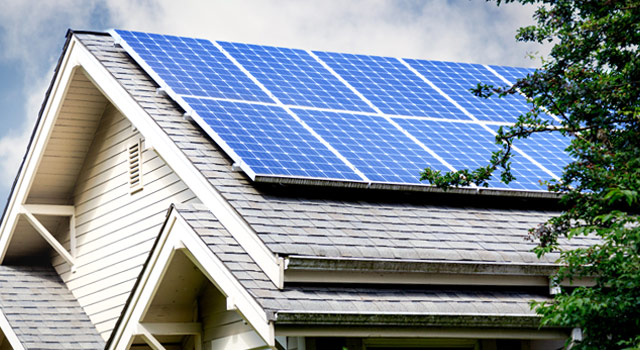
There are many potential advantages and disadvantages to solar energy. On the plus side, solar panels can cut your utility bills and carbon footprint. On the downside, it can cost you money if you decide to move before you recoup your initial investment. Before you go solar, make sure you consider the pros and cons.
Advantages of solar panels
One way to harness the power of the sun is through solar panels—either on rooftops or within large solar farms in rural areas. Here are some reasons why you might want to add solar panels to your home.
- Reduced electric bills
- Energy independence
- Cleaner energy source
- Improved home value
- Longevity and low maintenance
- State tax credits
Reduced electric bills
Perhaps the main advantage of switching to solar energy is to save money on your home’s monthly electric bill. This is because solar panels generate their own energy instead of relying on energy from a public-utility power grid. How much you save depends on several factors, including how much power you use, how much sun your roof gets, the size of your solar panel system, and whether you buy or rent the solar panels.
Energy independence
If you have a solar panel system with batteries, you can make your home completely independent from the power grid. Solar batteries store the energy that’s generated by your panels so you can use the energy whenever you need—not just during sunny hours. For example, a battery lets you run your lights and appliances at night, on cloudy days and during power outages.
Cleaner energy source
Electric power generation is a significant emitter of carbon dioxide. By installing solar panels on your home, you would be part of the solution to this problem, as solar energy systems do not emit carbon dioxide or contribute to air pollution. While the manufacturing of solar panels does produce some greenhouse gas emissions, it’s estimated that the environmental impact is offset in about one to four years.
Improved home value
Just like a renovated kitchen, solar panels can be a desirable upgrade for a lot of home buyers. As a result, solar panels tend to increase the value of your home. They can also help your home sell quicker than homes without solar energy.
Longevity and low maintenance
The only maintenance most solar panels need is a light cleaning each year to ensure that leaves and other debris don’t block the sun’s rays. If they stay clean, solar panels can operate for decades with minimal loss of efficiency. Fortunately, solar panels don’t require many ongoing costs, as they usually come with a full warranty for 20 to 25 years.
State tax credits
Certain states offer tax credits and rebates for solar energy purchases.
Disadvantages of solar panels
Installing solar panels comes with significant benefits, but there are some downsides, too. Here are some potential disadvantages:
- Expensive to install
- Doesn't work for every roof
- Could raise property taxes
- Long payback period
Expensive to install
The main components of a solar panel system include the panels themselves, the inverter (which converts the sun’s power into usable electricity) and batteries for storing power. Generally speaking, a complete solar panel installation can range from $10,000 to $50,000. The final figure depends on several factors, including:
- The size and type of the panels
- The complexity of your roof
- Local labor costs
- Permitting costs
- Any financial incentives available in your state
Doesn’t work for every roof
Certain aspects of your roof can affect the efficiency of your solar panels. If your roof includes some of the unfavorable conditions listed below, it doesn’t mean you’re completely out of luck, though. It just means that your solar panels might generate less energy.
| Favorable Roof Conditions | Unfavorable Roof Conditions |
|---|---|
| Unobstructed by trees or other structures | A well-shaded roof |
| Made up of asphalt shingles | Made up of cedar shakes or slate tiles |
| A slope between 15 and 40 degrees | A very steep roof |
| Receives direct sunlight; south-facing | Doesn’t receive a lot of direct sunlight |
Could raise property taxes
Homeowners with solar panels may end up paying more in property taxes. This is because solar panels typically increase home values. The good news is that some states have tax codes that allow homes with solar panels to avoid paying the additional property tax.
Long payback period
Because solar panel installation costs can be expensive, it may take several years for you to recoup your initial investment. For example, if the payback period is eight years, and you happen to sell your home before that, you may not see a return on your investment.
Are solar panels worth it?
Solar panels aren’t right for everyone. Generally speaking, they make the most sense for homeowners who can afford the upfront costs and own a home that gets consistent, unshaded sunlight. Solar panels might be right for you if:
- You can afford the upfront costs
- Your home receives a lot of direct sunlight
- Your energy usage and electric bills are high
- You’re not planning to move for many years
- You qualify for state tax incentives and rebates
FAQs on homeowners insurance
Let’s look at some frequently asked questions about solar panels and homeowners insurance.
Some standard home insurance policies cover damage to solar panels, some do not. If your policy does cover solar panels, how much coverage you have depends on where the solar panels are installed on your property.
- Solar panels attached to the roof are usually protected under your home policy’s Dwelling coverage.
- Solar panels that are mounted on top of a detached garage are covered under your home policy’s Other Structures coverage.
Adding solar panels to your home can affect your home insurance premium. The reason is fairly straightforward: Because roof-mounted solar panels are considered part of your dwelling, you may need to raise the limit on your Dwelling or Other Structures coverage to make sure the panels are covered. As a result, your annual home insurance premium may go up.
To ensure proper insurance coverage for your solar panels, follow these steps:
- Check your existing home insurance policy – Carefully review your current home insurance policy to determine if it already includes coverage for solar panels. Read through any specific terms and conditions related to solar panel coverage.
- Assess the value of your solar panels – Determine the current value of your solar panels, including the cost of installation, equipment and any related components. This information will help you determine the appropriate coverage amount that you need.
- Contact your insurance provider – Tell your insurance carrier or agent about your solar panel installation. Ask if your panels are adequately covered by your current policy. If they aren’t, ask your carrier or agent about any available endorsements, riders or add-ons to enhance your coverage for solar panels.
- Find out about possible exclusions – Ask your insurance carrier or agent about any policy exclusions related to solar panels. An exclusion is a specific type of damage that isn’t covered by your home insurance policy. Common exclusions to solar panels may include wear and tear, malfunctions, and potentially wind and hail.
- Update your insurance policy as needed – If you make any changes to your solar panel system, like adding more panels or upgrading equipment, inform your insurance carrier and update your policy accordingly. Failure to update your policy may result in insufficient coverage.