

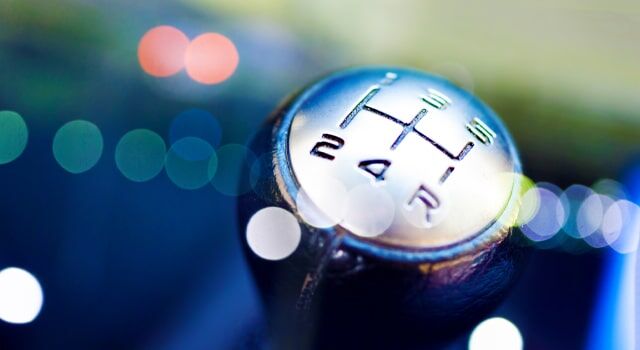
A car with a manual transmission allows drivers to change gears manually with a clutch pedal and gear shifter. Cars with automatic transmissions have the gear shift automatically for you.
What is a transmission?
Your car’s transmission is a gearbox that transfers power from your motor to your wheels. It’s one of the most important components of your car.
Transmissions are often referred to by their speed, which is the number of gear ratios available to use. For example, a five-speed transmission has five drive gear ratios.
What does a transmission do?
Using multiple gear ratios, a transmission can change your engine speed into different wheel speeds. Transmission gears start large and get smaller as they step up. The larger, lower gears transform high engine speed to low wheel speed that gives more power. This power is needed to get your heavy car moving from a stop.
As the car moves, it builds momentum and will need less power to maintain its movement. Smaller, higher gears are then used to maintain speed and improve fuel efficiency.
Battery / electric vehicles typically have a single gear transmission. While there are no other gears, an electric motor has enough torque to drive the car with just one gear.
What’s easier to drive: manual or automatic?
Automatic transmissions are often easier to drive because they require less effort from the driver.
Manual transmissions take time to master, as drivers must learn how to balance engine speed and gear changes. Driving a manual can also feel more stressful in certain situations, such as heavy traffic or steep hills.
For drivers looking for a simpler and more convenient driving experience, an automatic transmission is usually the better choice.
What is a manual transmission?
With a manual transmission, you change the gears manually with a clutch pedal and gear shifter. A manual transmission is made of a rod with several gears that connect to an output shaft to transfer power from the engine to the wheels.
A manual transmission typically has some number of drive gears, a reverse gear and neutral setting where no gear is engaged.
What is an automatic transmission?
In a car fitted with an automatic transmission, the car shifts gears for you automatically. There are a few different kinds of automatic transmissions, but an automatic will always handle the shifting for you.
An automatic transmission has parking, reverse, neutral and one or more drive modes.
Some cars let you tell the automatic transmission when to shift with paddles behind the steering wheel or with the shifter itself in a sport or manual mode, mimicking the feel and control of a manual transmission.
Other automatics may have a low gear mode that keeps the car in lower gears for driving in adverse conditions. There may also be an overdrive button that enables or disables the use of its higher gears.
Many recent cars are made with continuously variable transmission (CVT). A CVT uses a pulley to control the gear ratio, allowing a near infinite spectrum of gears. This functions similarly to an automatic.
What is the difference between 5 and 6-speed?
The main difference between a five-speed and six-speed transmission is how they handle overdrive. On the highway where it’s reasonable to drive at speeds around 65 miles per hour, overdrive gears help save fuel. The engine doesn’t need to work as hard to maintain speed. That extra sixth gear is even more efficient.
Are all automatic transmissions 6-speed?
No, not all automatic transmissions are 6-speed. Automatic transmissions can come in various gear counts including 4-speed, 5-speed, 6-speed, 8-speed, 10-speed and CVT.
Newer vehicles have more gears available to provide a larger ratio spread; this helps to provide better acceleration and fuel economy for the vehicle.
Which transmission is better?
Manual and automatic transmissions have different driving characteristics. One isn’t inherently better than the other. To help determine which one is right for you, let’s look at their differences.
Manual advantages
Manual transmissions allow you to have more direct interaction and control with the car. The driving experience in a manual can be more engaging, as the car responds quickly to driver input.
Since you have more control over how much power you put down, a manual transmission can be helpful for driving off-road or in mud, rain or snow.
These days, new manual cars are typically made for the enthusiast market. Only 1.7% of all cars sold in the United States as of 2023 are stick, but you might be able to find a good deal on an older car with a manual transmission.
Manual disadvantages
Shifting gears incorrectly can lead to damage to your transmission and engine. It takes time to learn how best to balance engine speed and gearing, and driving can be more stressful in some situations. It can also be exhausting to drive a manual car through traffic, as putting the car in gear repeatedly can be fatiguing. Backing up and parallel parking can be more difficult, especially on an incline.
Some safety features like automatic braking can’t be implemented on a manual car. Manual transmission options are typically offered only on lower trim levels for cars, so you may miss out on safety and comfort features when you go stick.
The ability to drive manual is already a lost art, so others may have difficulty driving your car. If you find yourself in a situation where you can’t drive and none of your friends can drive stick, our Get Home Safe program reimburses you for a one-way taxi ride per year.
Automatic advantages
Automatic transmissions are simpler to operate and make excellent vehicles to drive daily. For most people, an automatic transmission car is worry-free. The automatic transmission has numerous fail-safes to protect your engine from stressful operation.
Since the car controls everything, an automatic can have more advanced safety features, which can mean savings on your insurance.
On average, an automatic car gets better fuel economy than a manual of the same model.
Automatic disadvantages
An automatic transmission may shift gears at the wrong time. When turning, a sudden gear shift can upset the handling of the car.
Some automatics can feel unresponsive and lack power when you need to use it. Older automatics from before the mid-2000’s especially have this issue. Those older automatics are often slower and have worse fuel economy than their manual counterparts.
Cars with an automatic transmission are typically more expensive than the same model in manual.
While an automatic transmission is usually reliable, if something does break, it can be expensive to repair. The transmission itself is extremely complex, so fixing an automatic transmission usually involves replacing it entirely.
Need help? We’re here for you.
Phone

Online

Home insurance for Connecticut, Massachusetts, new Hampshire, New Jersey, New York and Pennsylvania
Agent
